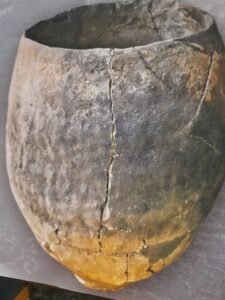


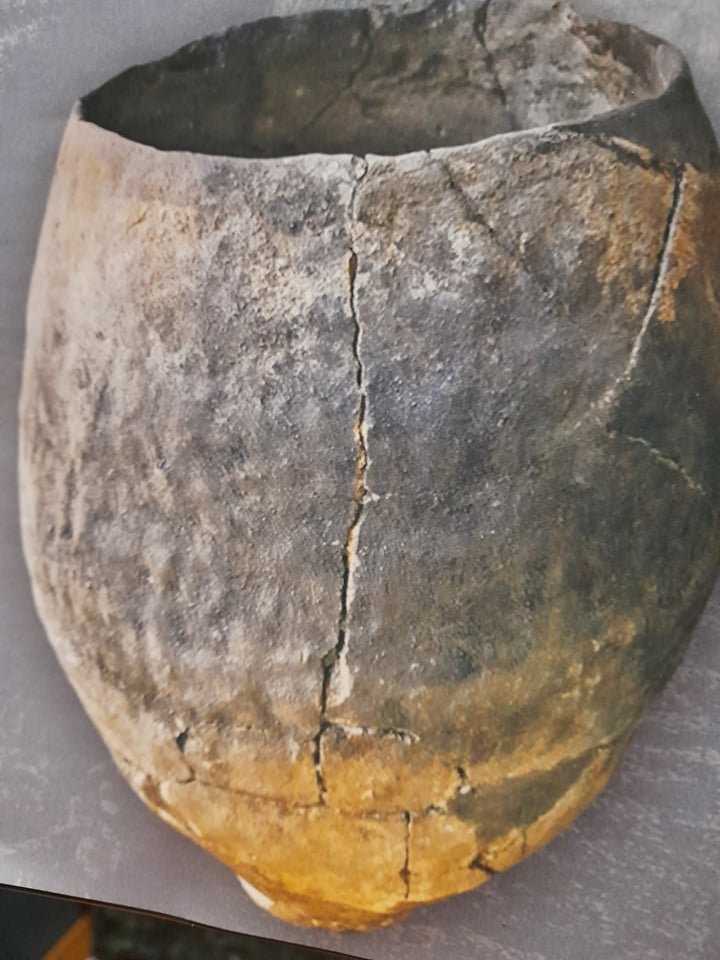
The ancient cheese storage vessel is 80 centuries old. This means that Georgian cheese has a history stretching back at least 8,000 years.
Archaeological evidence of this age is rarely found in the world of cheese archaeology.
You deserve to be called a living legend of Georgian cheese for bringing this story to light, Ana Mikadze-Chikvaidze…
Several years ago, Ana accidentally discovered that a cheese storage vessel dating back exactly 80 centuries was kept in the Historical Museum of Georgia. Following this discovery, she began speaking confidently about the 8,000-year history of Georgian cheese…
Cheese Storage Vessel: An 8,000-Year History in Georgia
Eight thousand years ago, making clay vessels was a task carried out by women and older people. Perhaps the craftsperson who made this cheese storage vessel was also a Neolithic Georgian woman. She shaped it, fired it over an open flame or dried it in the sun, and used it to store cheese…
Why was it used specifically for storing cheese?
Georgian cheese researcher Ana Mikadze-Chikvaidze discusses the facts and theories:
“This vessel is a very interesting archaeological find for the study of dairy products in the Caucasus. Two other vessels of a similar age are also preserved in Georgia. These specimens date back to the sixth millennium BC. All three were discovered at Neolithic settlements at Shulaveri and Imiri Gora. They were probably used to store dairy products.”
Unlike the other two vessels, this one has relatively thin walls. It appears that the craftsperson filled a bag with soil, shaped the vessel around it, and then dried it in the sun. Even the impressions of fingerprints are visible.
Traces of milk residue were found on this particular vessel, which is why researchers began to consider the possibility that it was used to store cheese.
Can we confidently say that this was a vessel for storing cheese?
“The traces of milk give us grounds to say so. Milk is a raw material with a shelf life of 72 hours; after that, it curdles. For me, as a researcher, curdled milk is already cheese. This subject can be debated endlessly.”
Why did people use vessels to store milk or cheese?
“They served the function of a refrigerator. People used them to store grain and other products. It is also possible that vessels were used to store milk and dairy products even before the Neolithic period.”
Eight Thousand Years of Georgian Cheese in a Small Booklet
“In your interviews, you have mentioned that the 2,800-year-old milk strainer you saw at the Mtskheta Archaeological Museum led you to the 80-century-old vessel…”
“It is true that I found archaeological artefacts at the Mtskheta Archaeological Museum and the Tbilisi Historical Museum. However, I never rely solely on my own ideas and assumptions. I always turn to the opinions of respected scholars, such as Ms Tamila Tsagareishvili and Mr Paata Bukhrashvili. These two distinguished scholars worked on the booklet Eight Thousand Years of Georgian Cheese, which presents cheese-related artefacts preserved in Georgian museums.”
For more information about Georgia’s archaeological heritage, visit the official Georgian National Museum website and explore the archaeological sites of Georgia.
Discover More About Georgian Cheese on Travel News
Learn more about Ana Mikadze-Chikvaidze and Georgia’s traditional cheese-making heritage in these related Travel News articles:
- Ana Mikadze-Chikvaidze – The Queen of Cheese – Discover the researcher’s work documenting Georgia’s diverse cheese traditions.
- Dambalkhacho and Kalti – Provisions for Warriors – Explore traditional Georgian cheeses and the stories behind them.
- Who Created Sulguni Aged in Honey? – Learn about the traditional technique of preserving cheese in honey.
- Gastronomy Tourism in Georgia – Discover Georgia’s culinary heritage and gastronomic tourism opportunities.
Author: Shorena Merkviladze
Interviewee: Ana Mikadze-Chikvaidze
Travel News – Tourism Partner Media
For article and media partnership enquiries: info@travelingeorgia.ge