


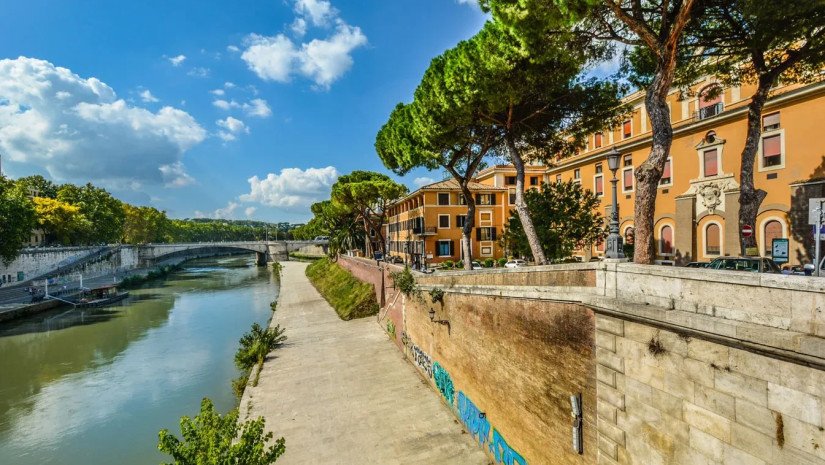
The Tiber River in Rome is one of the city’s most important historical and geographical landmarks. The river has been closely connected with Rome for thousands of years. Today, it remains an important part of the city’s historic landscape and tourism experience.
The Tiber flows through Rome from north to south. It passes close to many famous landmarks. Its banks are home to Tiber Island and several historic bridges. The official Rome tourism portal also highlights the river’s connection with Rome’s history and tourist routes.
The Tiber River and the History of Rome
The Tiber River in Rome played an important role in the development of the city. For centuries, the river served as a transport and trade route.
The Tiber also has a central place in the legend of Rome’s foundation. According to the traditional story, the twins Romulus and Remus were abandoned on the river in a basket. They survived and were later connected with the foundation of Rome.
The official Rome tourism portal also links the Tiber with the legend of Rome’s origins. It highlights the river’s role in the city’s development over the centuries.
The Tiber River in Rome and the Historic Center
The Tiber flows close to the historic center of Rome. It forms an important part of the city’s urban landscape and famous views.
Several major attractions are located near the river. These include Castel Sant’Angelo, the Vatican area, Trastevere and Testaccio. The Tiber also passes near many historic squares and monuments.
The Tiber River in Rome is therefore more than a natural feature. It is part of the city’s history. It is also an important element of Rome’s tourism routes.
Famous Bridges Over the Tiber
The historic bridges of the Tiber are among the river’s main attractions. Rome has many bridges crossing the river. Some of them date back to ancient Roman times.
Ponte Fabricio
Ponte Fabricio, also known as the Fabrician Bridge, connects Tiber Island with the left bank of the river.
According to the official Rome tourism portal, the bridge was built in 62 BC. It is one of the oldest Roman bridges still in use.
Ponte Sant’Angelo
Ponte Sant’Angelo is one of the most recognizable bridges over the Tiber. It is closely connected with Castel Sant’Angelo and the route toward St. Peter’s Basilica.
The bridge was originally known as Pons Aelius. It was built by Emperor Hadrian in the 2nd century AD. Today, it is one of the historic landmarks along the Tiber.
More information about the bridge is available through the official Rome tourism portal.
Ponte Sublicio
Ponte Sublicio is also connected with the ancient history of Rome. The modern bridge stands near the location associated with the ancient Pons Sublicius.
The present bridge connects areas of Rome near Trastevere and Testaccio. Its history is closely linked with the Tiber and the development of the city.
The official Rome tourism portal provides additional information about Ponte Sublicio.
Tiber Island
Tiber Island, or Isola Tiberina, is the only urban island in the Tiber River in Rome. It is located in the historic center. The island remains one of the city’s distinctive landmarks.
The island is connected to the riverbanks by two historic bridges. They are Ponte Fabricio and Ponte Cestio.
According to the official Rome tourism portal, Ponte Fabricio was built in 62 BC. Ponte Cestio dates back to the Roman period.
What Can You See Along the Tiber?
Walking along the Tiber offers a different way to explore Rome. Historic bridges, old neighborhoods and architectural landmarks can be found along the river.
The areas around Trastevere and Testaccio are interesting for visitors. The river also provides views of several important landmarks.
The official Rome tourism portal highlights boat trips on the Tiber. These trips offer visitors a different perspective of Rome.
The Tiber River Today
Today, the Tiber River in Rome remains an important part of the city’s urban landscape. Its banks are used for walking, cycling, leisure and tourism activities.
The river also continues to host different activities. Several sections of the Tiber are navigable. Boat trips offer another way to experience Rome.
According to the official Rome tourism portal, boat trips can provide different views of the city. Visitors can also explore areas near the river and its historic landmarks.
Why Is the Tiber River in Rome Important for Tourism?
The Tiber River in Rome connects the city’s history, architecture, legends and modern tourism experience.
Visitors can explore historic bridges and neighborhoods along its banks. They can also see important landmarks from a different perspective.
The Tiber’s importance goes beyond its natural role. For centuries, the river was closely connected with Rome’s development. Today, it remains an important part of the city’s identity and tourist landscape.
For travelers visiting Rome, walking along the Tiber is an opportunity to experience the historic center from a different perspective.
For more information about tourism development and destinations, read our article about Georgia’s Tourism Potential.