


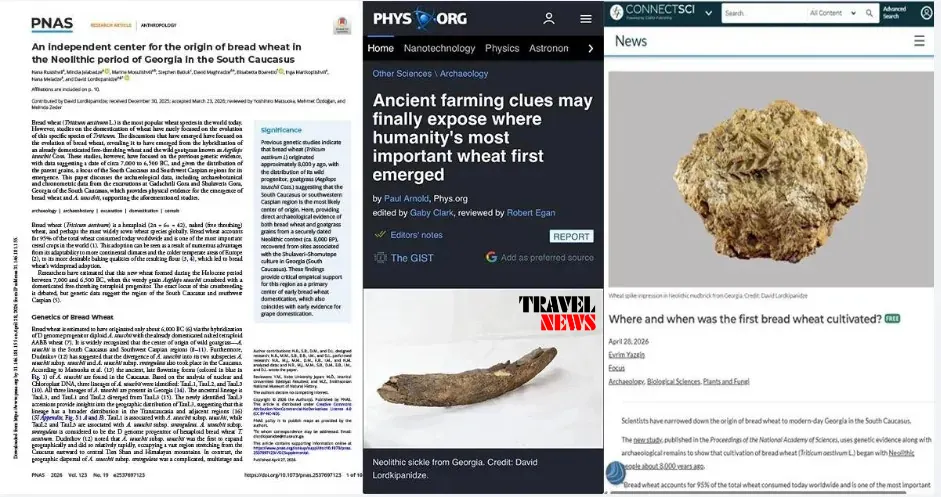
A paper entitled “The South Caucasus, Georgia, an Independent Centre of Bread Wheat Origin in the Neolithic Period” has been published in the Proceedings of the National Academy of Sciences of the United States of America (PNAS). The article confirms that Georgia represents an independent and now documentarily verified ancient cradle of bread wheat (Triticum aestivum).
According to Georgia’s Ministry of Culture, the paper is based on an international multidisciplinary study led by Academician David Lordkipanidze. It draws on 8,000-year-old archaeological material excavated in Georgia at the Shulaveri Gora mounds, as well as on the long-standing scientific research of paleoethnobotanist Professor Nana Rusishvili.
As the Ministry of Culture highlights, radiocarbon dating conducted at the Weizmann Institute of Science in Israel has confirmed that the material uncovered at Neolithic settlements in Georgia represents the oldest known physical evidence of bread wheat anywhere in the world.
The study’s co-authors include both Georgian and international scholars: Mindia Jalabadze, Inga Martkoplishvili, Marine Mosulishvili, Nana Meladze, David Maghradze, Elisabetta Boaretto, and Steven Batiuk.
“The international multidisciplinary research was carried out under the aegis of Georgia’s Ministry of Culture and the National Wine Agency’s project ‘Research and Promotion of Wine and Vine’, with the support of the University of Toronto, the Weizmann Institute of Science, and the Society Iveria,” the ministry’s statement reads.
The ministry also announced that a presentation of the groundbreaking scientific study, which confirms Georgia as the oldest known origin of bread wheat, will take place at the National Museum on May 1 at 14:00.
1tv.ge